

For a long time, medical websites were essentially digital business cards—static pages listing a phone number, an address, and a list of services. That era is over. In 2026, patients demand much more than basic information. They expect speed, instant gratification, and a seamless digital experience that mirrors the care they receive in person.
When a potential patient lands on your site, they are often anxious, in pain, or pressed for time. If they encounter slow loading speeds, confusing menus, or a lack of immediate booking options, they don’t just get frustrated; they leave. They click the “back” button and head straight to a competitor.
With years of experience in healthcare website design, we have analyzed data from hundreds of clinic websites. We know exactly what converts a casual visitor into a loyal patient—and what drives them away. The stakes are higher now because your website is often the very first interaction a patient has with your practice.
This guide covers the critical design features that modern clinics need to compete effectively. We will look at how accessibility, mobile-first architecture, and integrated booking systems are reshaping the industry standards for healthcare website design trends 2026 this year.
Why Healthcare Website Design Matters for Clinics Today
First impressions are everything, especially in medicine. Studies show that users form an opinion about a website in approximately 0.05 seconds. In that blink of an eye, a potential patient decides if your clinic looks professional, trustworthy, and modern.
A generic, outdated website subconsciously signals to patients that your medical technology or practice management might also be behind the times. Conversely, a polished, user-centric site builds immediate authority. It tells the visitor that you pay attention to detail and care about their experience.
However, aesthetics are only half the battle. Clinics need websites built for both users and search engines like Google. A beautiful site that no one can find is a wasted investment. The best healthcare website design trends 2026 combines usability, credibility, and performance to create a powerful engine for practice growth.
Mobile-First Design Is Non-Negotiable in 2026
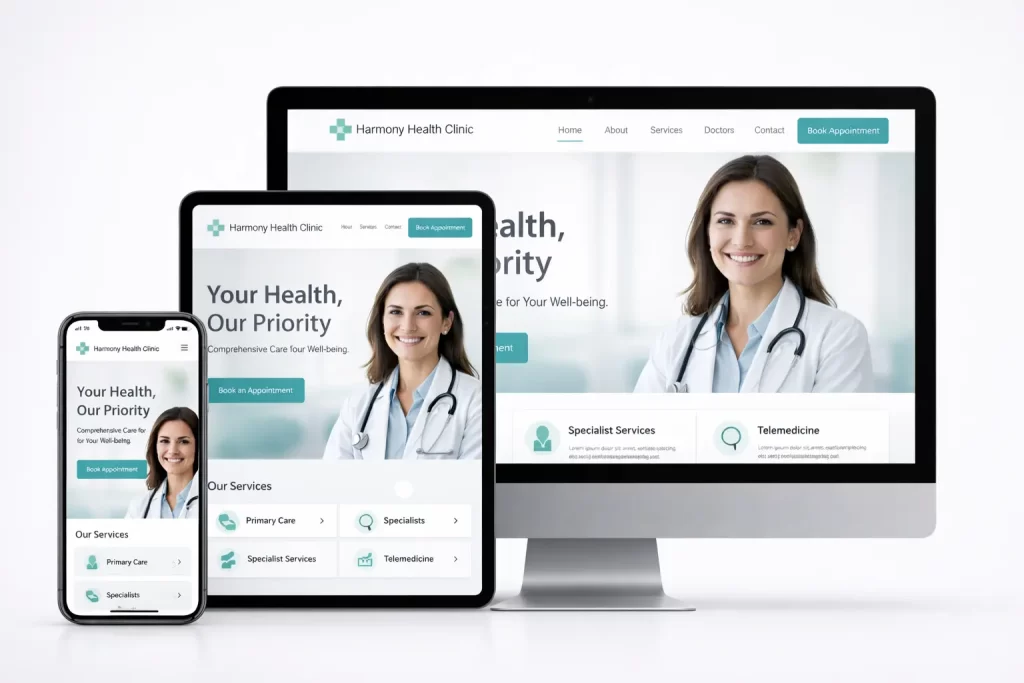
If you look at your clinic’s analytics, you will likely see that the majority of your traffic comes from smartphones. Patients are searching for symptoms, looking up doctors, and booking appointments while on their lunch break, on the bus, or waiting in line.
Designing for desktop first and treating mobile as an afterthought is a strategy that fails in 2026. Mobile-first design ensures that buttons are thumb-friendly, text is readable without zooming, and navigation is intuitive on a smaller screen.
Furthermore, Google uses mobile-first indexing. This means the search engine primarily looks at the mobile version of your site to decide where you should rank. If your mobile experience is clunky, your SEO rankings will suffer, making it harder for new patients to find you.
Online Appointment Booking for Higher Conversions
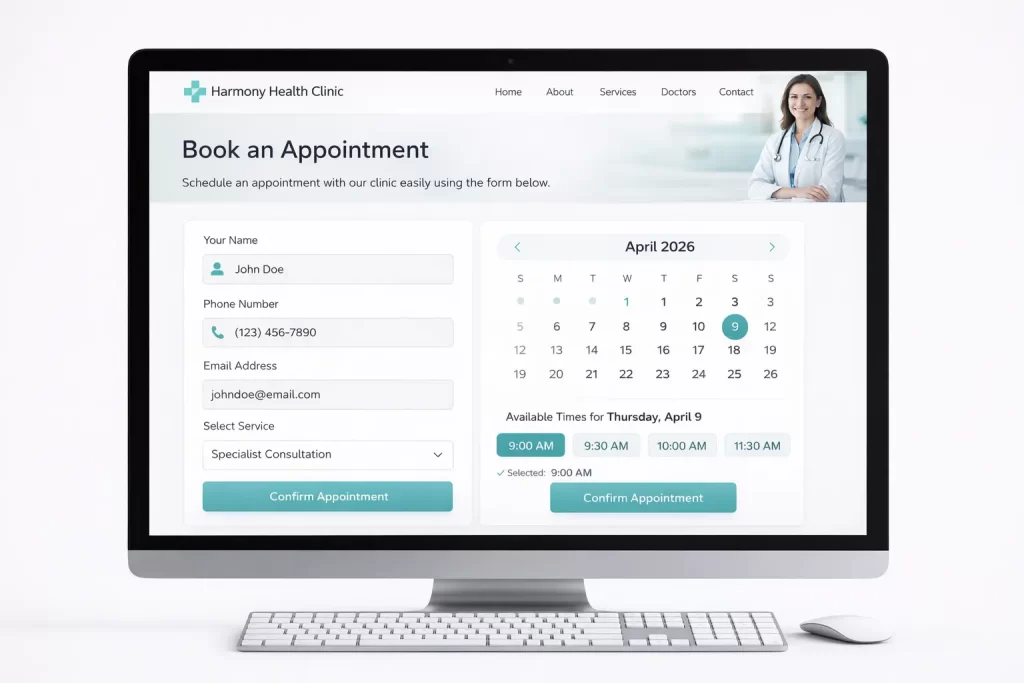
The modern patient values convenience above almost everything else. They do not want to call a front desk, wait on hold, and go back and forth comparing calendar availability. They want to see open slots and book an appointment instantly.
Integrating a robust online scheduling tool does two things. First, it significantly increases your conversion rate. When you reduce friction, more people complete the process. Second, it drastically reduces the administrative burden on your front office staff. Instead of fielding routine scheduling calls, your team can focus on patient care and in-clinic experience.
Pro Tip: Place your “Book Appointment” CTA (Call to Action) prominently above the fold—meaning the user should see it immediately without scrolling. It should be the most visible button on your homepage.
Fast Loading Speed Builds Patient Confidence
Patience is rare online. If your website takes more than three seconds to load, bounce rates skyrocket. For a healthcare provider, a slow website suggests inefficiency. If your digital infrastructure is sluggish, patients might wonder if your administrative processes are equally slow.
Page speed is also a confirmed ranking factor for Google. Faster sites rank higher. To ensure your site is lightning-fast, you need to look at technical optimization:
- Compressing high-resolution images so they load quickly without losing quality.
- Using reliable, high-performance hosting specifically designed for traffic spikes.
- Minimizing heavy code and scripts that run in the background.
Speed isn’t just a technical metric; it is a trust metric.
HIPAA-Compliant Security and Patient Privacy Features
Security is the backbone of any medical platform. Unlike a standard business website, a healthcare site often handles sensitive inquiry forms, patient portal logins, and personal health information (PHI).
Ensuring your website is HIPAA-compliant is not optional. At a minimum, your site requires an SSL certificate (the padlock icon in the URL bar), which encrypts data transferred between the user and the server. Beyond that, any forms on your website—whether for contact, intake, or prescription refills—must be secure and compliant with data privacy regulations.
Privacy-first design protects your patients and protects your practice from significant legal liabilities. Highlighting your security measures in the footer or near booking forms can also reassure visitors that their data is safe with you.
Clear Navigation That Helps Patients Find Answers Quickly
When someone visits a doctor’s website, they usually have a specific goal. They want to know if you accept their insurance, if you treat their specific condition, or where your office is located.
Your navigation menu should be the roadmap that gets them there in the fewest clicks possible. Avoid clever or abstract labels; stick to clear, standard terms like “Our Services,” “Doctors,” “Insurance,” and “Contact.”
Cluttered menus overwhelm users. If a patient cannot find what they need within seconds, they will assume you can’t help them.
Expert Insight: In healthcare, simplicity equals trust. A clean, organized structure suggests a calm, organized medical practice.
Patient Testimonials and Trust Signals That Improve Credibility
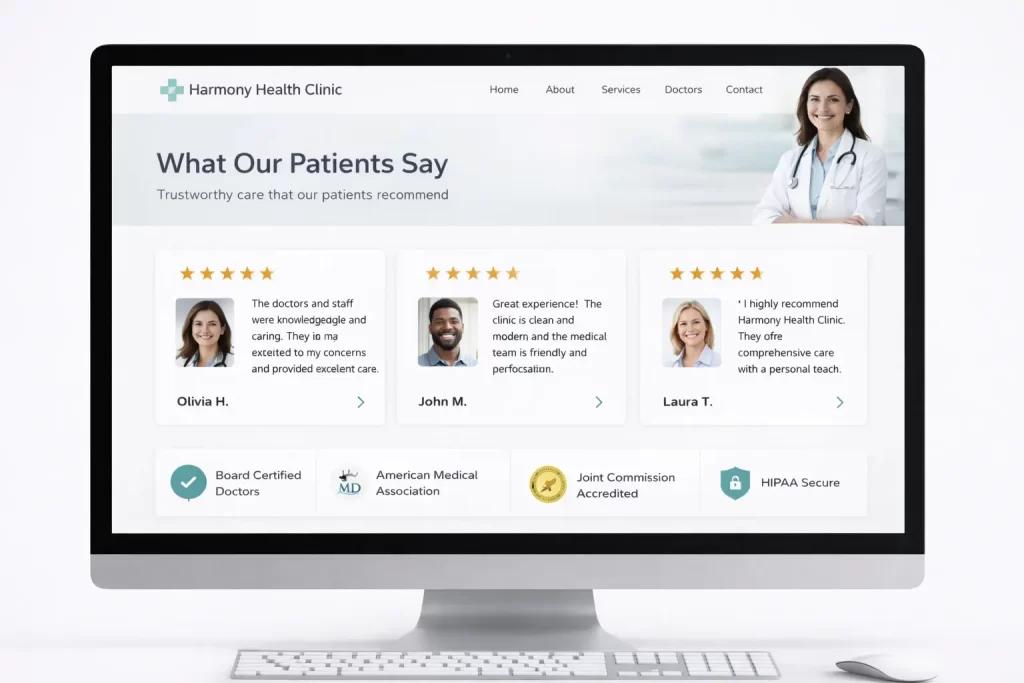
You can tell patients how great your clinic is, but they will always trust other patients more. Social proof is a psychological phenomenon where people copy the actions of others in an attempt to undertake behavior in a given situation. In healthcare, this means reading reviews.
Integrating real patient success stories and testimonials directly onto your homepage can dramatically increase conversions. However, ensure these are used ethically and in compliance with medical advertising regulations in your region.
In addition to reviews, display other trust signals. Show off “Top Doctor” awards, board certifications, and professional memberships. These badges serve as visual shorthand for expertise and safety.
Local SEO Features for Clinic Visibility
Most healthcare searches are local. People search for “pediatrician near me” or “best cardiologist in [City Name].” To capture this traffic, your website needs to be optimized for local SEO.
This involves embedding a Google Map directly on your contact page, ensuring your Name, Address, and Phone number (NAP) are consistent across every page, and creating location-specific service pages if you have multiple clinics.
Great healthcare website design supports both patients and search engines. By structuring your location data correctly, you help Google understand exactly where you are and who you serve, making it more likely you will appear in the “Local Pack” map results at the top of a search page.
Accessibility and Inclusive Website Design for All Patients
Medical websites have a moral and legal obligation to be accessible to everyone, including people with disabilities. ADA (Americans with Disabilities Act) compliance is becoming the standard for healthcare website design.
This means your site needs high contrast between text and background colors for visually impaired users. It needs to support screen readers for blind users. Fonts should be scalable and legible.
Designing for accessibility isn’t just about compliance; it is about better User Experience (UX). An accessible site is easier for elderly patients to use, and since seniors make up a large portion of healthcare consumers, this is a critical demographic to serve well.
Modern Visual Branding Trends in Healthcare Website Design (2026)
The visual language of healthcare is shifting. Gone are the days of sterile, cold, clinical blues and stock photos of people in white coats shaking hands. In 2026, the trend is toward warmth, empathy, and modernization.
We are seeing a move toward calming, clean layouts with ample white space. This minimalist approach reduces cognitive load, helping anxious patients feel a sense of calm before they even walk through your doors.
Avoid outdated templates that look like they were built ten years ago. Custom photography of your actual staff and clinic space resonates much better than generic stock images. Clinics aiming for the best healthcare website design focus on clarity and calm visuals to build an emotional connection with the visitor.
Common Mistakes Clinics Make With Outdated Websites
Even excellent doctors can be undermined by a bad website. Here are the most common pitfalls we see:
- No Mobile Optimization: Forcing users to “pinch and zoom” to read text.
- Slow Load Times: Heavy videos or unoptimized images drag down speed.
- Poor CTA Placement: Hiding the phone number or booking button in the footer.
- Hard-to-Use Booking Systems: Forcing patients to fill out ten pages of forms just to request a time slot.
- PDF Menus: Uploading service lists or forms as PDFs that have to be downloaded instead of web pages that can be read instantly.
Correcting these errors is often the fastest way to improve your patient acquisition numbers.
How a Healthcare Website Design Agency Helps Clinics Grow Faster
You might be tempted to build a site yourself using a DIY builder, but healthcare websites have specific complexities—from HIPAA compliance to local SEO—that general builders often miss.
Working with an experienced healthcare website design agency ensures your clinic website performs like a real business tool. An agency brings professional strategy, UX planning, and conversion optimization to the table. They don’t just make it look pretty; they engineer the site to rank on Google and convert visitors into patients.
They handle the technical debt, the security requirements, and the mobile responsiveness, allowing you to focus entirely on treating patients.
Related Healthcare Web Design Services

If you are ready to explore specialized solutions for your specific field, we have dedicated resources to help you:
- If you run a dental practice, explore our Dental Website Design Solutions to see how we tailor user flows for high-value cosmetic and general dentistry patients.
- For broader healthcare businesses, check our complete Medical Website Design Services, which covers everything from multi-location hospitals to private specialized clinics.
Final Thoughts — Ready to Upgrade Your Clinic Website?
A modern clinic website is not optional in 2026. It is the hub of your patient acquisition strategy and the face of your brand. Design impacts trust, bookings, and ultimately, the growth of your practice.
The right features—speed, mobile responsiveness, accessibility, and security—can transform the patient experience from frustrating to effortless. By investing in your digital presence, you are investing in the long-term success of your clinic.
Looking for the Right Team? Your Search Ends Here
If your clinic website feels outdated, slow, or is not generating appointments, it may be time for a redesign.
As a trusted agency specializing in website design for healthcare, we help clinics build high-performing websites that:
✅ Rank higher on Google
✅ Load faster
✅ Convert visitors into patients
✅ Look modern and professional
🚀 Contact us today to get a free clinic website redesign consultation.
FAQ Section
What makes the best healthcare website design?
The best design balances aesthetics with functionality. It must be mobile-responsive, fast-loading, and easy to navigate. Crucially, it must prioritize the patient journey, making it simple to find information and book appointments while maintaining a professional and trustworthy visual identity.
Do clinics need HIPAA compliance on their websites?
Yes. If your website collects any patient information—including names, phone numbers, or health details through a contact form—it must be secure. While a standard brochure site without forms has fewer requirements, any data transmission needs to be encrypted and compliant with privacy laws to avoid fines and protect patients.
How much does a healthcare clinic website redesign cost?
The cost varies significantly based on complexity. A small, local clinic site will cost less than a large hospital network with patient portal integrations. Generally, you are paying for the expertise in UX, SEO, and security that keeps your practice competitive. It is best to view this as an investment in a 24/7 marketing tool rather than a one-time expense.
Should I hire a healthcare website design agency?
Hiring a generalist web designer often leads to missed opportunities in local SEO and compliance. A specialized healthcare agency understands the patient mindset, the regulatory environment (like HIPAA), and the specific keywords that drive medical traffic. This specialized knowledge usually results in a higher return on investment.
How often should a healthcare website redesign be done?
A healthcare website redesign is typically recommended every 2–3 years to keep up with evolving technology, user expectations, and compliance standards, ensuring the website remains effective, secure, and user-friendly.
