

Your website is often the first—and sometimes only—chance you get to make a strong impression on potential customers. A professionally built site signals credibility, drives conversions, and sets the foundation for long-term digital growth. A poorly built one does the opposite, often faster than you’d expect.
That’s why so many businesses, from lean startups to established enterprises, choose to hire website developers rather than patch something together with a drag-and-drop builder. DIY tools have their place, but they rarely deliver the custom functionality, security, or SEO-friendly website development that modern businesses actually need.
This guide covers everything you need to know before bringing developers on board: the difference between design and development, the types of services available, industry-specific solutions, key hiring criteria, cost expectations, and the trends shaping web development in 2026.
Understanding Website Design vs Development
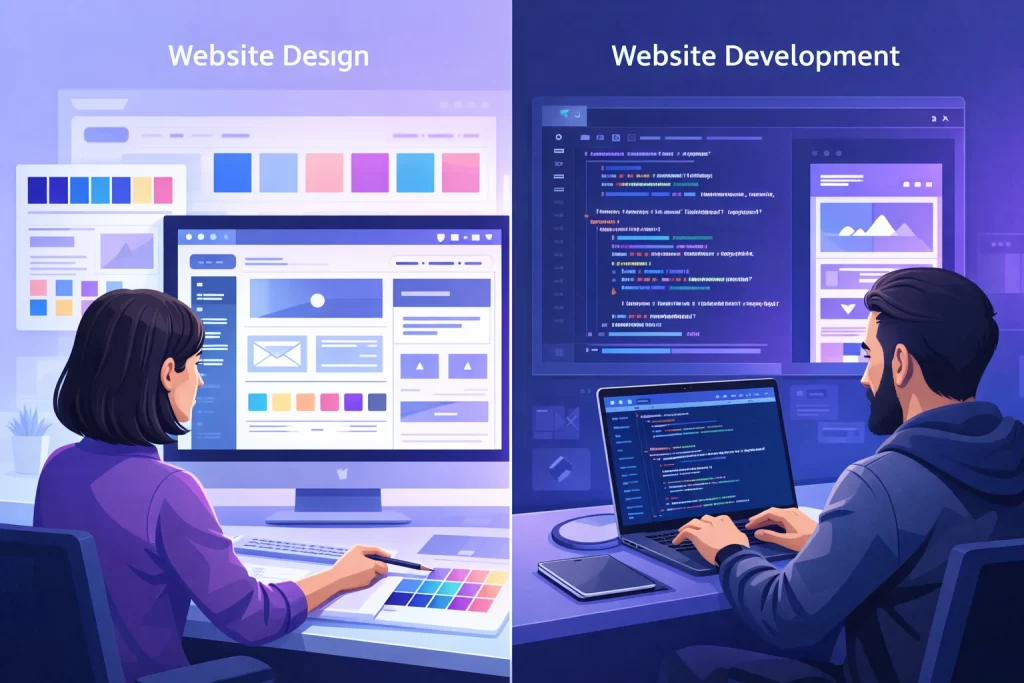
These two terms often get used interchangeably, but they describe very different disciplines. Knowing the distinction helps you hire the right people—and avoid costly miscommunication.
What Is Website Design?
Website design focuses on how a site looks and feels. Designers handle the user interface (UI), which covers visual elements like color schemes, typography, buttons, and layouts. They also shape the user experience (UX), ensuring visitors can navigate the site intuitively and find what they’re looking for without friction. Branding plays a central role here too—your design should reflect your identity consistently across every page.
What Is Website Development?
Development is what happens under the hood. Developers write the code that makes your site function, build databases to store information, and manage server-side logic that powers dynamic features. When a user submits a form, processes a payment, or logs into an account, that’s development at work.
Website Design vs Development: Why Businesses Need Both
A beautifully designed site with broken functionality frustrates users. A highly functional site with poor design loses them before they convert. The most effective websites are the result of close collaboration between designers and developers—two different skill sets working toward the same goal.
Why Businesses Need to Hire Professional Website Developers

There’s no shortage of website builders promising quick, affordable results. The trade-off? Limited flexibility, generic outputs, and long-term technical debt. Here’s what professional developers bring to the table.
Custom Functionality
Every business has unique requirements. Whether you need a custom booking engine, a client portal, or complex product filtering, professional developers build features tailored to your workflows—not constrained by a template’s limitations.
Better Performance and Security
Page speed directly impacts bounce rates and search rankings. Professional developers optimize load times, implement secure coding practices, and configure hosting environments that protect your business and your users from vulnerabilities.
SEO-Friendly Website Development
Building a site that ranks well on Google isn’t just about adding keywords. It requires clean code, proper URL structures, fast load speeds, mobile responsiveness, and structured data implementation—all technical elements that experienced developers handle from the ground up. SEO-friendly website development from the start is far more effective than trying to retrofit it later.
Scalability for Future Growth
Your website needs to grow with your business. Professional developers architect sites with scalability in mind, so adding new features, handling increased traffic, or expanding into new markets doesn’t require rebuilding from scratch.
Types of Website Development Services Businesses Need
Not all web development projects are the same. Understanding the major service categories helps you identify what kind of expertise you’re actually looking for.
Enterprise Website Development
Large corporations, SaaS platforms, and global brands need websites that handle high traffic volumes, integrate with complex internal systems, and maintain performance across multiple regions. Enterprise website development involves robust architecture, custom integrations, and rigorous security protocols.
B2B Website Development
B2B websites serve a distinct purpose: generating leads and facilitating business transactions between companies. They typically require detailed product or service pages, gated content, CRM integrations, and buyer-journey-focused UX that guides decision-makers through a longer sales cycle.
White Label Website Development
Agencies frequently outsource development work to white-label partners—developers who build under the agency’s brand. White label website development allows agencies to scale their capacity without hiring full-time staff, making it a cost-effective option for handling overflow projects or specialized technical work.
Industry-Specific Website Development Solutions
Generic websites rarely meet the specialized demands of regulated or high-stakes industries. Here’s how development differs across key sectors.
Healthcare Website Development
Healthcare websites must balance usability with strict compliance requirements. Healthcare website development often involves patient portal integration, online appointment booking, secure messaging systems, and adherence to privacy regulations like HIPAA. The stakes for security and accessibility are exceptionally high.
Medical Website Development
Clinics, specialists, and healthcare providers need more than a standard business site. Medical website development focuses on telemedicine integration, symptom checkers, staff directories, and patient intake forms—features that reduce administrative burden while improving patient experience.
Real Estate Website Development
Property search is inherently complex. Real estate website development typically includes MLS/property listing integrations, interactive map features, advanced filtering, and CRM connections that help agents track leads and manage follow-ups efficiently.
Hotel Website Development
For hospitality businesses, the website is a direct revenue channel. Hotel website development centers on real-time booking engines, room and availability management, dynamic pricing displays, and secure payment gateways—all working together to reduce reliance on third-party booking platforms.
Technologies Used by Professional Website Developers
The technology stack behind your website shapes its flexibility, performance, and long-term maintainability.
CMS Website Development Services
Content management systems like WordPress, Shopify, and Drupal allow non-technical teams to update content without developer involvement. CMS website development services offer faster build times, lower ongoing costs, and a vast ecosystem of plugins and extensions. WordPress powers roughly 40% of all websites globally—a testament to its versatility. Shopify dominates e-commerce, while Drupal suits complex, enterprise-level content needs.
PHP Website Development Services
PHP remains one of the most widely used server-side languages, powering platforms like WordPress, Magento, and Laravel-based custom applications. PHP website development services are well-suited to businesses needing custom-built, scalable applications with specific backend logic that off-the-shelf platforms can’t accommodate.
Key Factors to Consider Before You Hire Website Developers
Choosing the wrong developer costs time, money, and momentum. Evaluate candidates against these criteria before making a decision.
Experience and Portfolio
Look for developers with a track record in projects similar to yours. A strong portfolio demonstrates not just technical ability, but an understanding of how websites perform in real-world business contexts.
Technology Expertise
Confirm that a developer’s technical skills align with your project requirements. Someone who specializes in WordPress may not be the right fit for a custom PHP application—and vice versa.
Industry Knowledge
Developers who understand your industry will ask better questions, anticipate challenges, and deliver solutions that fit your operational reality. This is especially relevant in healthcare, real estate, and hospitality.
SEO Knowledge
Your developer should understand the technical foundations of SEO-friendly website development. If they’re not familiar with Core Web Vitals, structured data, or mobile-first indexing, your site could rank poorly before it even launches.
Post-Launch Support
A website isn’t a finished product on launch day. Confirm what ongoing support, maintenance, and update services are available. Clear expectations here prevent headaches down the line.
Where to Find Professional Website Developers
The right hiring channel depends on your project scope, budget, and timeline.
Freelance Developers
Freelancers are cost-effective for smaller, well-defined projects. Platforms like Upwork and Toptal connect businesses with vetted developers across a range of specializations. The trade-off is that managing freelancers requires more hands-on oversight.
Web Development Agencies
Agencies offer end-to-end services, from strategy and design through to development and ongoing support. They’re typically more expensive than freelancers, but bring structured processes, dedicated project management, and a broader skill set under one roof.
White Label Development Partners
For agencies looking to expand their service offering without growing their team, white label website development partners provide a discreet, scalable solution. The agency maintains the client relationship while the white label partner handles execution.
Cost of Hiring Website Developers in 2026
Pricing varies widely depending on project complexity, developer experience, and location.
Small Business Website Cost
A professionally built small business website typically ranges from $3,000 to $15,000. This covers a custom design, core functionality, mobile responsiveness, and basic SEO setup.
Enterprise Website Development Cost
Enterprise website development projects are far more resource-intensive. Depending on the scope, costs can range from $50,000 to well over $500,000, factoring in custom integrations, high-availability infrastructure, and extensive testing.
Custom Website Development Pricing Factors
Several variables influence final pricing: the number of pages and features, CMS or custom technology stack, third-party integrations, ongoing maintenance agreements, and the developer’s location and experience level. Always request itemized proposals so you understand exactly what you’re paying for.
Common Mistakes Businesses Make When Hiring Developers
Avoiding these errors can save you significant time and money.
Choosing Based Only on Price
The cheapest option rarely delivers the best value. Low-cost developers may cut corners on code quality, security, or testing—problems that become expensive to fix after launch.
Ignoring SEO-Friendly Website Development
Many businesses treat SEO as an afterthought, only to discover their newly launched site performs poorly in search. Integrating SEO considerations into the development process from day one is far more effective and efficient.
Not Planning Scalability
Building a website that meets your current needs without accounting for future growth is a short-sighted decision. Revisiting architecture later is costly and disruptive.
Not Understanding Website Design vs Development
Confusing these disciplines leads to misaligned briefs and underqualified hires. Knowing what you need—design, development, or both—ensures you find the right expertise for the job.
Future Trends in Website Development (2026)

The web development landscape continues to shift. Here’s what’s gaining ground this year.
AI-Powered Websites
Artificial intelligence is enabling dynamic, personalized web experiences at scale. From AI-powered chatbots to content personalization engines that adapt based on user behavior, AI is reshaping how websites engage visitors.
Headless CMS
Headless CMS architecture decouples the backend content management system from the frontend presentation layer. This gives developers greater flexibility to deliver content across multiple platforms—websites, apps, and IoT devices—while still giving content teams an intuitive management interface. CMS website development services are increasingly embracing headless approaches for enterprise clients.
Faster and SEO-Optimized Development
Google’s continued emphasis on Core Web Vitals has made speed and performance central to development strategy. Frameworks prioritizing fast loading, minimal JavaScript, and clean rendering pipelines are dominating enterprise website development projects.
Industry-Specific Website Solutions
The demand for purpose-built solutions in healthcare, real estate, and hospitality continues to grow. Generalist websites are giving way to highly tailored platforms that address the specific workflows, regulations, and user expectations of each sector.
Conclusion
Hiring the right team to hire website developers is crucial for building a professional and scalable online presence. The right developers can create a high-performance website that supports business growth and delivers a great user experience.
At SRH Web Agency, we specialize in helping businesses hire website developers for custom solutions, including B2B website development. Our experienced team focuses on building modern, SEO-ready websites that help companies grow, attract clients, and succeed online.
