
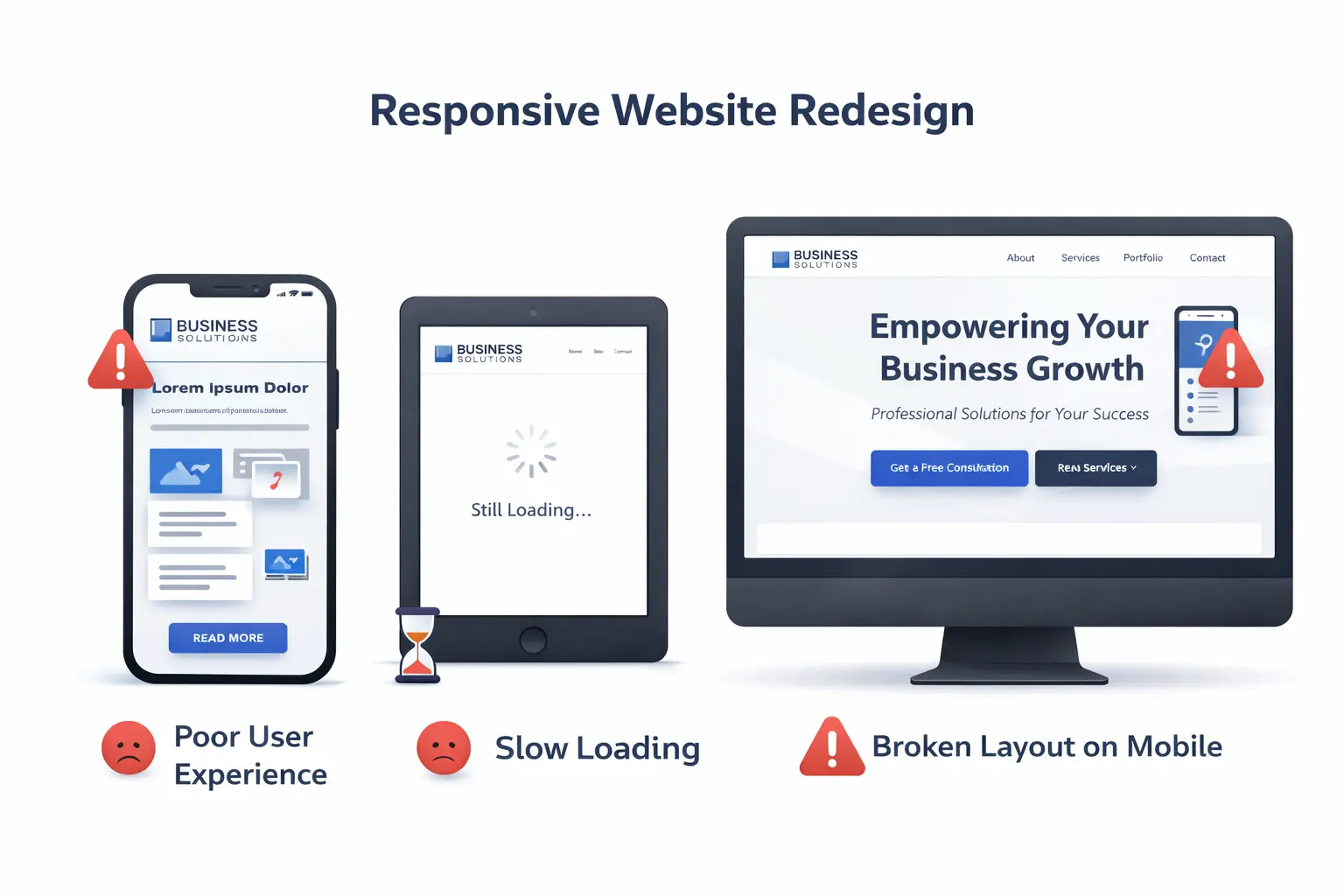
Your website is often the first interaction a potential customer has with your brand. In those first few seconds, judgments are made about your professionalism, credibility, and capability. Yet, many business owners treat their website like a “set it and forget it” asset.
It’s easy to fall into the trap of thinking, “It’s still online, so it’s working.” But there is a massive difference between a website that functions technically and one that converts visitors into paying customers. The digital landscape changes rapidly. Design trends shift, user behaviors evolve, and Google’s algorithms are constantly updated. A site that was cutting-edge three years ago might now be actively hurting your bottom line.
Procrastination is common. A full website redesign feels like a daunting project. You might worry about the cost, the time commitment, or the potential disruption. However, sticking with an underperforming site is often more costly in lost revenue than fixing it.
This guide isn’t about convincing you to change your site for vanity’s sake. It is a strategic checklist designed to help you objectively evaluate whether your current digital presence supports your business goals or holds you back.
What Does a Website Redesign Really Mean?
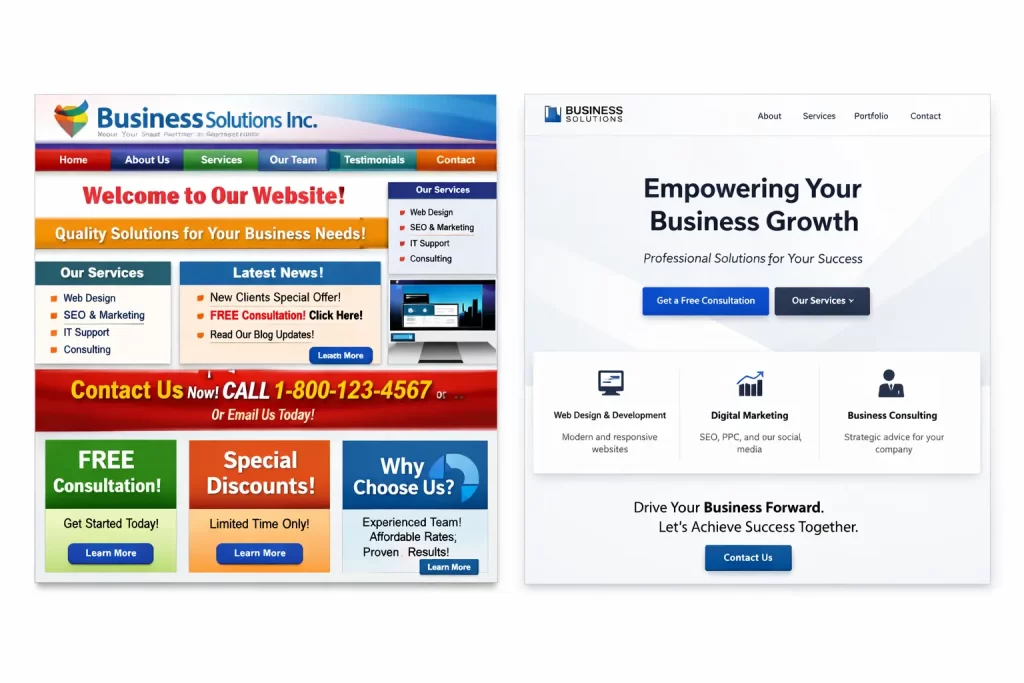
Before we dive into the checklist, let’s clarify what we are talking about. Many business owners confuse a “refresh” with a redesign.
A refresh might involve swapping out some photos, changing a few headlines, or updating a logo. A true website redesign, however, is a fundamental overhaul. It goes beyond the surface level to address the core architecture of your site. It involves evaluating the user experience (UX), the technology stack, the content strategy, and the conversion paths.
When you hire a professional website redesign service, the goal isn’t just to make the site “prettier.” The goal is to make it perform better. This includes:
- Strategy: Aligning the site structure with current business objectives.
- Performance: Improving code to ensure lightning-fast load times.
- Responsiveness: Ensuring flawless operation on every device, from iPhones to desktops.
- SEO: Building a foundation that search engines can easily crawl and rank.
If your site has fundamental issues with how users navigate it or how Google reads it, a coat of paint won’t fix the rot. You need a structural renovation.
The Website Redesign Checklist for Business Owners
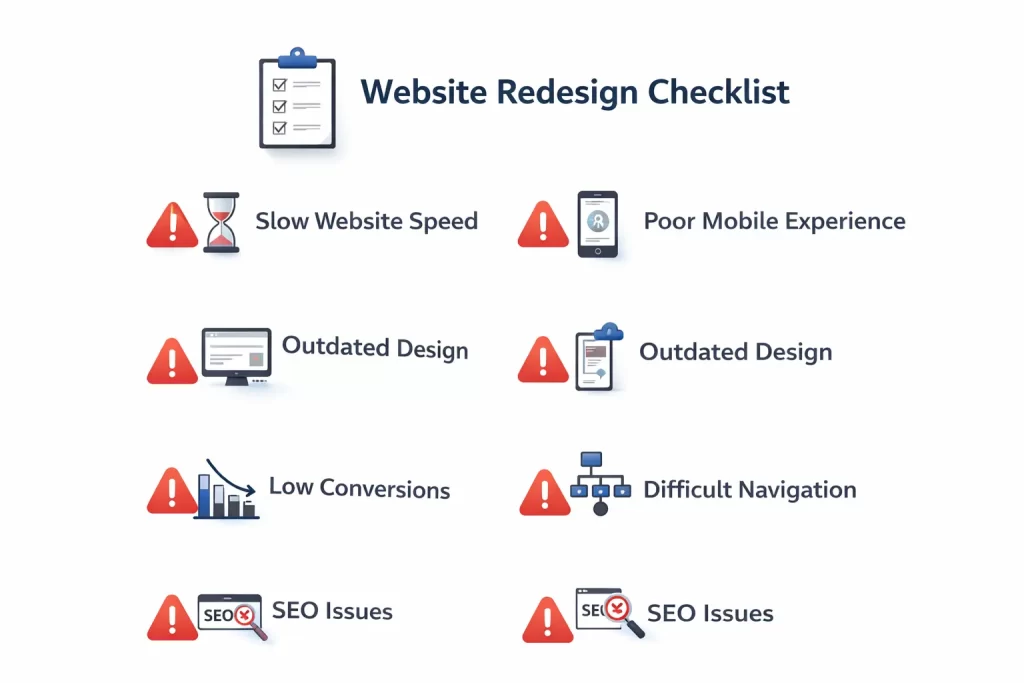
How do you know if you’ve crossed the line from “needs a tweak” to “needs an overhaul”? If you find yourself nodding along to three or more of the following points, it is likely time to take action.
1. Your Website Looks Outdated Compared to Competitors
First impressions are 94% design-related. If your competitor’s site looks modern, sleek, and intuitive, and yours looks like it was built in 2015, you are losing trust before the customer reads a single word.
Users associate modern design with modern business practices. An outdated site suggests that your company might be behind the times, slow to adapt, or struggling financially. Browse the websites of your top three competitors. Be honest: does your site look like the industry leader, or does it look like the budget option?
2. Your Website Is Not Optimized for Mobile Users
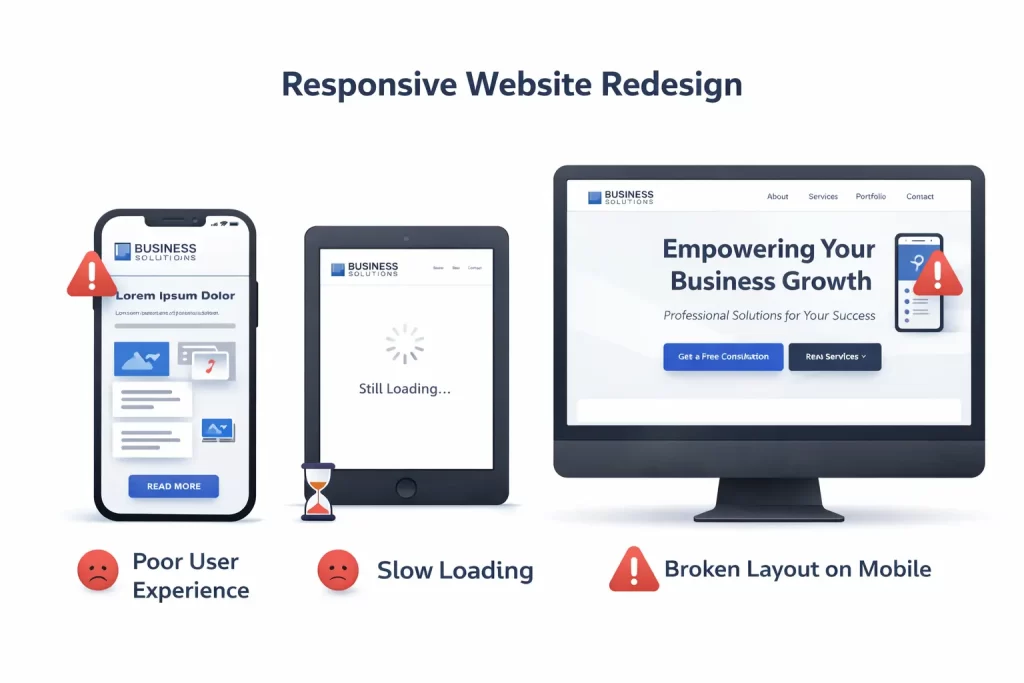
This is non-negotiable. Mobile traffic accounts for approximately half of all web traffic worldwide. If your site isn’t “responsive”—meaning it doesn’t automatically adjust to look great on smartphones and tablets—you are alienating 50% of your audience.
But it goes deeper than just shrinking the desktop version. Mobile users behave differently. They tap instead of click. They need larger buttons and streamlined menus. If users have to pinch-and-zoom to read your text, they will leave. Furthermore, Google uses “mobile-first indexing,” meaning it predominantly looks at the mobile version of your site to determine your ranking. A bad mobile experience equals bad SEO.
3. Your Website Takes Too Long to Load
We live in an era of instant gratification. 40% of consumers will wait no more than three seconds for a web page to render before abandoning the site.
Speed isn’t just a convenience factor; it’s a revenue factor. Slow sites have higher bounce rates and lower conversion rates. Often, old websites are weighed down by bloated code, uncompressed images, and outdated plugins. A website redesign allows developers to rebuild the site using clean, modern code that loads instantly, keeping users engaged.
4. You Get Traffic but Very Few Leads
This is perhaps the most frustrating scenario for business owners. You can see in your analytics that people are visiting your site, but the phone isn’t ringing, and the contact forms are empty.
This is a classic user experience (UX) and conversion rate optimization (CRO) failure. It suggests that while your marketing might be working, your website is failing to close the deal. The user journey might be confusing, your calls-to-action (CTAs) might be weak or hidden, or your value proposition might be unclear. A strategic redesign focuses heavily on mapping out user paths to guide visitors seamlessly toward a purchase or inquiry.
5. Your Business Has Grown, but Your Website Hasn’t
Businesses evolve. You might have launched new services, pivoted your focus, or moved upmarket to target enterprise clients. If your website still reflects the business you were five years ago, it’s creating a disconnect.
For example, if you started as a general contractor but now specialize in luxury kitchen remodels, a generic “handyman-style” website will repel the high-end clients you want to attract. Your website must mirror your current brand identity, messaging, and service offerings accurately.
6. Managing or Updating Your Website Is Difficult
Your marketing team should be able to update content easily. If adding a new blog post, changing a team member’s photo, or updating a price requires you to email a developer and wait a week, your CMS (Content Management System) is failing you.
Modern websites are built on user-friendly platforms that allow business owners to make day-to-day changes without knowing code. If your backend is clunky, insecure, or requires a degree in computer science to navigate, a redesign is necessary to regain control of your digital asset.
7. Your SEO Performance Is Declining or Not Improving
Search engine algorithms are incredibly sophisticated. They prioritize site speed, security (HTTPS), mobile usability, and structured data. Older sites often lack the technical foundation to support these requirements.
If you are investing in content and backlinks but your rankings are stagnant or dropping, technical debt is likely the culprit. A redesign allows you to restructure your URL hierarchy, improve your site map, and implement the latest technical SEO best practices from the ground up.
How Often Should a Business Consider Website Redesign?
There is no expiration date stamped on a website, but the general rule of thumb in the digital industry is every 2 to 4 years.
Why this timeline?
- Technology: Web standards change. Browsers update, security protocols tighten, and coding languages become more efficient.
- Design Trends: What looked “clean” three years ago may look sterile or boring today. Visual styles shift, and user expectations shift with them.
- Business Cycles: Most businesses undergo significant changes in strategy or offering every few years.
However, timing shouldn’t be dictated solely by the calendar. It should be dictated by data. If your site is three years old but still converting at a high rate and ranking #1, you might only need a refresh. If your site is two years old but has a high bounce rate and breaks on mobile, you need a website redesign immediately.
Website Redesign vs. Minor Website Updates: How to Decide
Not every problem requires a bulldozer. Sometimes, a renovation is enough. How do you distinguish between needing a website redesign service versus just some maintenance?
Minor Updates are enough when:
- You are happy with your overall branding and conversion rates.
- The site is mobile-friendly and loads quickly.
- You just need to add a new page, change some text, or swap a few images.
- Your technology stack (CMS, plugins) is up to date and secure.
A Full Redesign is necessary when:
- The underlying technology is obsolete (e.g., you’re running on a legacy version of PHP or an unsupported CMS).
- The site structure (navigation) is confusing and needs a total rethink.
- You are undergoing a major rebrand (new logo, new colors, new name).
- The user experience is driving customers away (high bounce rates).
- The site is not mobile-responsive.
Think of it like a house. If the paint is peeling, you paint it (update). If the foundation is cracking and the wiring is a fire hazard, you rebuild (redesign).
Will a Website Redesign Affect SEO?
This is the number one fear business owners have: “If I redesign my site, will I lose all my Google rankings?”
The answer is: It depends on who does the work.
If you hire an amateur or do it yourself without SEO knowledge, yes, you can tank your rankings. Changing URLs without redirects, removing high-performing content, or messing up the site structure can be disastrous.
However, if you work with a reputable website redesign agency, the process should actually improve your SEO. A professional agency will perform a comprehensive content audit before touching a single pixel. They will:
- Map out 301 redirects to ensure old links point to new pages.
- Preserve high-value keywords and content.
- Improve site speed and mobile usability (ranking factors).
- Implement proper schema markup.
SEO safety is a critical part of the redesign process. It’s not an afterthought; it’s a foundational element.
What a Professional Website Redesign Service Includes
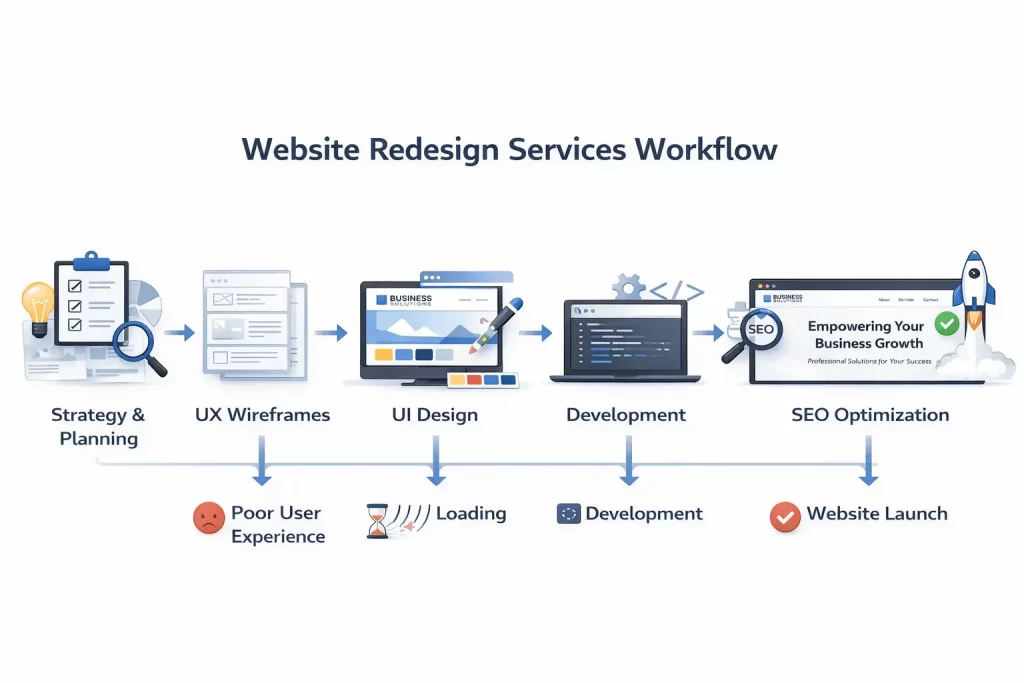
When you engage with professional website redesign services, you aren’t just paying for a graphic designer. You are paying for a multi-disciplinary team. A comprehensive project usually includes:
- Discovery & Strategy: Analyzing competitors, defining user personas, and setting conversion goals.
- UX/UI Design: Creating wireframes and prototypes to test user flows before building the final look.
- Development: Custom coding ensuring a secure, fast, and bug-free experience.
- Content Strategy: rewriting or optimizing copy to align with the new design and SEO goals.
- SEO Migration: Ensuring all link equity is preserved during the switch.
- QA & Testing: Rigorous testing on various browsers and devices.
- Training: Teaching your team how to use the new CMS.
This holistic approach ensures that the new site is a business tool, not just a digital brochure.
When Should You Contact a Website Redesign Agency?
Look back at the checklist in section three.
- 0-2 checks: You are likely fine with minor updates or a visual refresh.
- 3-5 checks: Your website is leaking revenue. You should start planning a budget and researching partners.
- 6-7 checks: Your website is an emergency. It is actively damaging your brand reputation.
The risks of DIY solutions or cheap templates are high. Templates are often bloated with unnecessary code (slowing down the site), offer limited customization, and provide zero strategic guidance. You might save money upfront, but you pay for it in lost leads and frustrating maintenance later.
An expert evaluation from a website redesign agency can provide clarity. They can look under the hood and tell you if your issues are cosmetic or structural.
Is Website Redesign the Right Move for Your Business?
Deciding to redesign your website is an investment of capital and time. It requires you to look critically at your business and define where you want to be in the next few years.
But consider the alternative. Can you afford to have 50% of your visitors leave because your site doesn’t work on their phones? Can you afford to look less professional than the competitor down the street?
A redesign isn’t a cost; it’s a growth strategy. It signals to the market that you are active, modern, and customer-focused. By addressing the issues on this checklist, you stop losing leads to technical friction and start building a platform that works as hard as you do.
Ready to Take the Next Step?
If you recognize several of these signs on your own website, it might be time to get a professional opinion before making any big decisions.
We offer a free website audit to help business owners understand whether a full website redesign is actually needed—or if a few strategic improvements can solve the problem. This isn’t a sales call. It’s an honest assessment focused on performance, user experience, and long-term growth.
Our website redesign services are designed to be consultative, not pushy. The goal is simple: help you make the right decision for your business, even if that means waiting or choosing a different approach.
If you’d like clarity on your next move, a quick audit can save you time, money, and unnecessary rework.
